
The 79th National Tea Competition 第79回全国茶品評会 Results (2025)
The 79th National Tea Competition (第79回全国茶品評会) took place in Nara Prefecture from August 26 to 29, 2025 — marking the first time in 15 years the event has been hosted in the region.
The venue was the Nara Prefectural Agricultural Cooperative Wide-Area Tea Distribution Center in Tsuge Shiraishi, Nara City.
This year, a total of 819 teas were submitted by producers from 18 prefectures across Japan. The competition covered eight categories, including Tencha (unground Matcha), gyokuro, sencha, and kamairicha.
Judging was carried out by a panel of 20 experts representing research institutes and industry organizations from major tea-producing areas nationwide.
Award for Production Area
In addition to rewards to individual farmers, there are awards given to production regions.
An award presented annually to municipalities that achieve outstanding results in the national and Kansai regional tea competitions for each tea category. The winners are determined based on the total score of the top three entries in the judging.
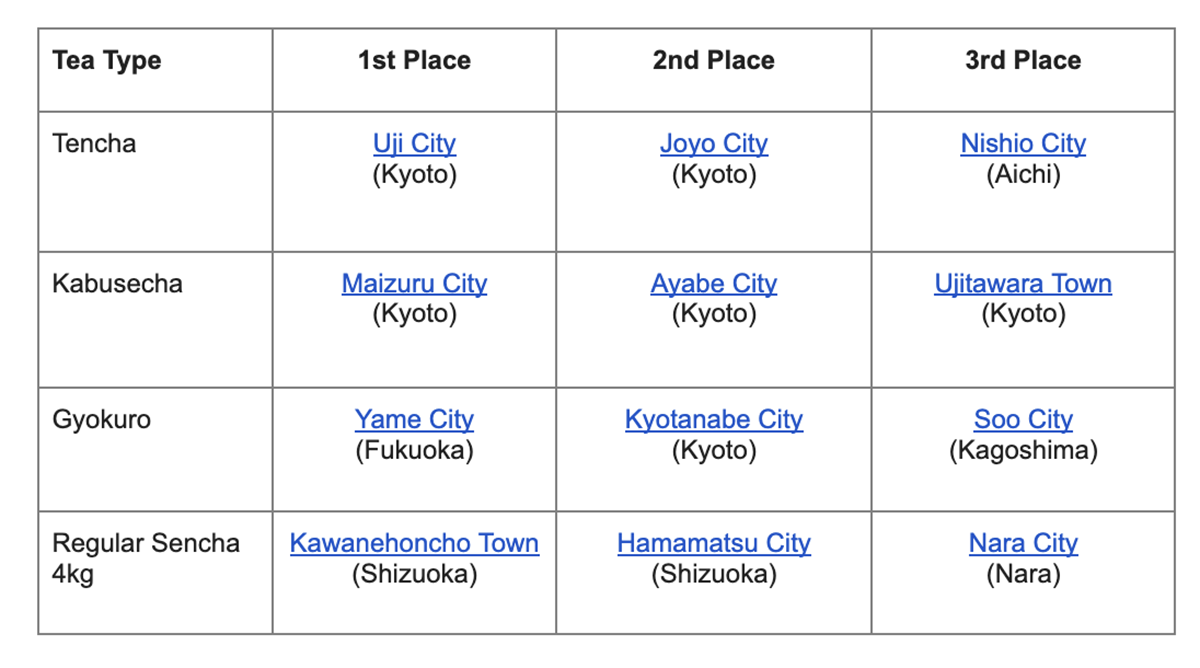
No surprises this year with the Tencha (unground Matcha) category. First place was Uji city, Kyoto - the birthplace of Matcha. In second place was Joyo City, also within Kyoto prefecture. In third place is Nishio City, in Aichi.
Regarding entries from Kyoto: “The top-ranking entries showcased a bright, vibrant green color, the distinctive fragrance of shaded Tencha, a liquor with depth and richness, and outstanding quality highlighted by abundant umami.”
First Place Winners in Tencha
We’ll cover individual awards. In Tencha (unground Matcha) there is a maximum of 200 possible points that can be awarded. This year saw a perfect score of 200, going to the first place winner in Tencha. As it happens, all the top 5 rankings for Tencha were from Uji City, Kyoto. That gives you an understanding of how exceptional tea from this region is.
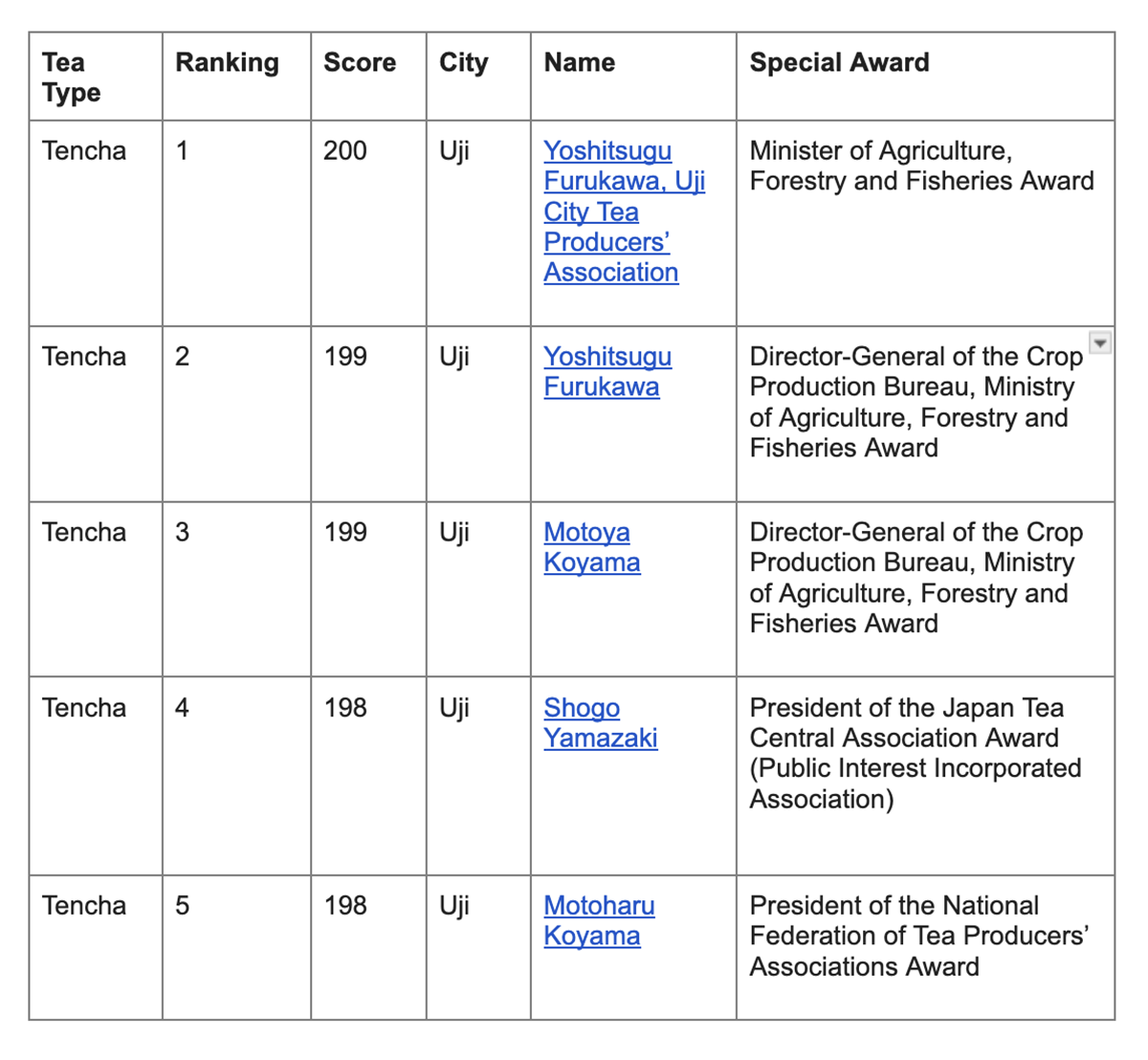
This year’s first place went to Yoshitsugu Furukawa of Gokasho, Uji with a perfect score of 200. In second is another entry from Yoshitsugu Furukawa of Gokasho, Uji with a score of 199. In third was Motoya Koyama of Uji city with a score of 199. In fourth was Shogo Yamazaki of Gokasho, Uji with a score of 198.
General Review of Judging
The Chief Judge, Yasushi Sato (Head of the Tea Research Division, Institute of Fruit Tree and Tea Science, NARO), had this to say regarding the Tencha submitted:
“There were 100 entries submitted from eight prefectures, including Kyoto, Aichi, and Shizuoka. Among the top-ranking teas were those distinguished by a vivid, bright green appearance, the characteristic fragrance unique to shaded Tencha, a liquor with notable depth and concentration, and an excellent internal quality with abundant umami.
The difference in quality between the middle and upper tiers felt relatively small. On the other hand, in the lower-ranked entries, some exhibited uneven or insufficient coloration in appearance, while others showed leaf damage odors, off-flavors, or noticeable bitterness and astringency in taste. With demand for Tencha continuing to rise in recent years, it is hoped that this competition will serve as a catalyst for improving tea quality nationwide.
This year proved to be a difficult one for tea production. High temperatures and drought from last summer through late autumn, followed by low temperatures in early spring, resulted in a nationwide decline in the first flush harvest. At the same time, rapid growth in demand, both for exports and inbound tourism, significantly shifted the supply-demand balance and tea prices.
Despite such challenges, many producers submitted teas to the competition, and I would like to express my deepest respect for the passion and dedication of all producers and those involved. Across all categories, the entries were truly outstanding, each embodying the unique characteristics of its tea type. In particular, many of the top entries were of such exceptional quality that it was difficult to rank them, leaving a strong impression of the high level of cultivation and manufacturing techniques on display.”
More on Competitions
The national tea competition is important, but in Kyoto there’s also a regional Kansai Tea Competition. A Furukawa took first in both this year’s national competition (Yoshitsugu Furukawa) and the regional Kansai competition (Mizuho Furukawa). You can learn more about the Kansai Tea Competition here.
Japanese tea prices hit record highs in 2026. Learn how global Matcha demand drove up first and second harvest prices with Ooika’s Matcha Industry Report.